22 Jun 2026
Building a Guandan Rules Deck
A weekend experiment using deep research, AI image generation and a custom editorial deck skill to produce an illustrated Guandan rules deck from scratch.
Overview
Guandan is a climbing card game played with two standard decks, typically in partnerships of two. It is wildly popular in China, particularly among professionals and business circles, where it apparently occupies the social space that golf fills elsewhere.
I was introduced to Guandan during my company’s team-building event in May this year. I have always enjoyed card games like poker, and Guandan had enough complexity to pull me in. The rules are deceptively layered: card rankings shift depending on the current level, there are wild cards and bombs of varying strength, and the promotion mechanics reward both individual hand strength and team coordination. Even colleagues who had played before struggled to recall all the rules.
What started as casual curiosity soon became a very specific itch: surely there had to be a better way to explain this game. So, in the spirit of turning a mildly confusing card game into an unnecessarily structured side project, I built a complete Guandan rules deck using AI tools from end to end.
The process looked something like this:
- Research. I used ChatGPT Deep Research and Perplexity Pro Deep Research, with both instructed to consult English and Chinese sources and focus on the Shanghai variant, since Guandan rules can differ slightly across cities.
- Outline and image prompts. I used Claude to distil the research into a structured slide outline, then write consistent image-generation prompts for each slide.
- Graphics. I generated the visuals using ChatGPT’s image generation, based on the prompts from Claude. I also drew on a database of image-generation prompts I have been collecting from X, Threads and Rednote, which I maintain in Notion using the same Claude-powered workflow I wrote about previously.
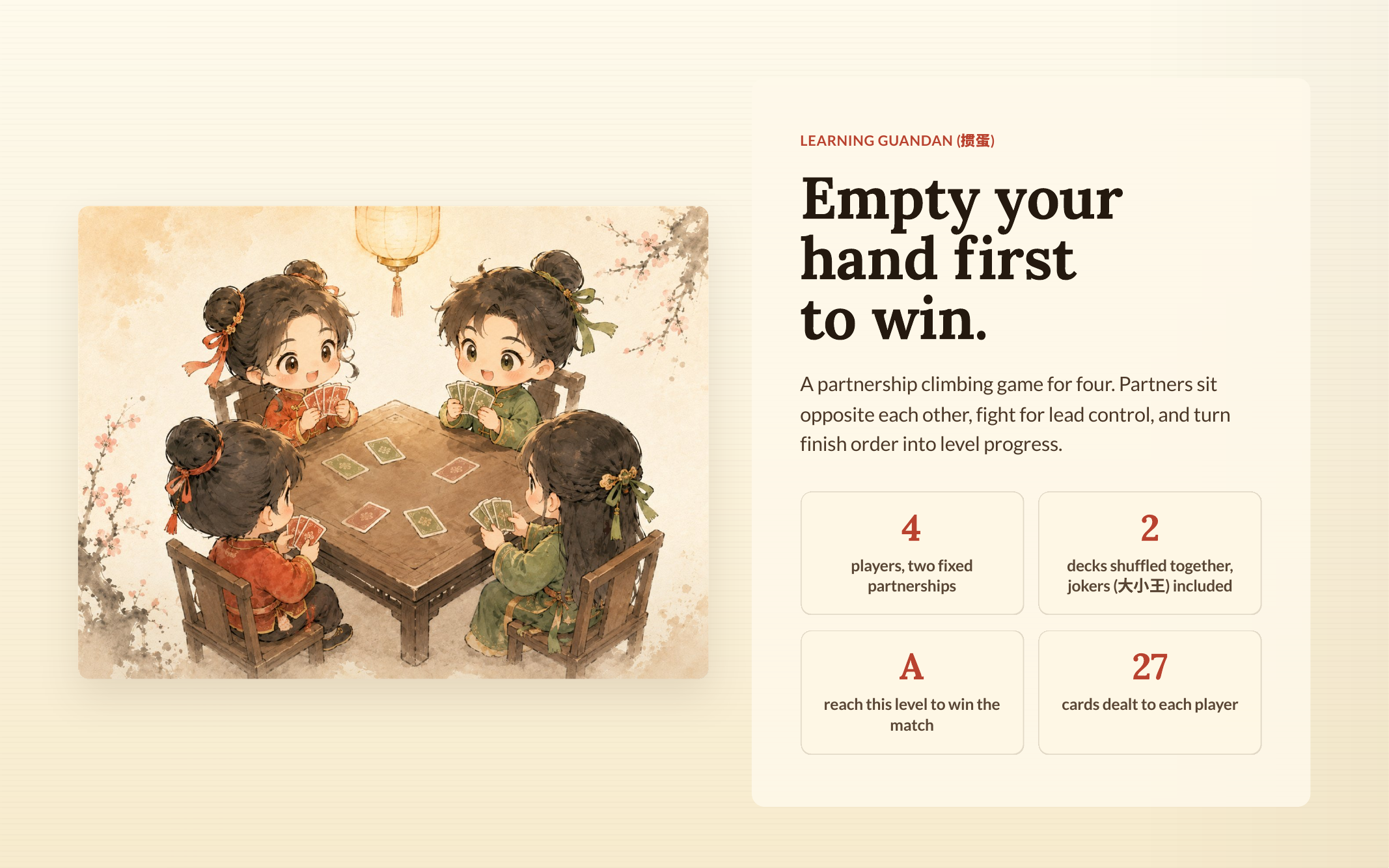
- Deck assembly. I went back to Claude, fed in the outline and generated images, and used my editorial deck skill to produce the final HTML deck with typography, transitions, navigation, and an English/Chinese language toggle.
- Verification. I used Claude again, this time spawning three agents: a complete beginner, a casual player, and a competitive tournament player. Their job was to stress-test the deck from every angle. The beginner flagged missing basics, such as hand size and passing rules. The casual player caught rule inaccuracies, including the permissible lengths of pair runs (连对) and steel plates (钢板) under Shanghai rules. The competitive player identified rules that needed more precision, including the anti-tribute rule and the rule about advancing from level A and winning the game.
HTML Deck
It took several iterations to come up with the finalised deck, but I am pretty satisfied with the outcome!