19 Jun 2026
Curating Notion Databases with Claude
Using Claude and Notion to build a personal record of taste: what I read, where I eat, and what I thought at the time.
Overview
Long before tools like Claude and ChatGPT came along, Notion was already my note-taking app, task manager, to-do list and second brain. I still use it that way today, but AI has changed how information gets into the system.
I also use Notion to maintain several databases around things I want to remember: restaurants I have visited, books I have read, gaming-industry developments I want to track, clothing purchases and other personal reference points.
I did, however, encounter some issues with maintaining these databases. The value of these databases depends on capturing entries while they are still fresh, but manually adding each restaurant, book, article or purchase into Notion was just enough friction for the habit to become inconsistent.
Claude changed that.
With Model Context Protocol, or MCP, Claude can connect directly to Notion. In practical terms, this means Claude can read and write database entries directly, rather than waiting for me to copy information across manually. These days, I type a short message or send a voice note to Claude in the relevant Project folder. Claude works out which database the entry belongs in, creates the record, and fills in the relevant fields. In other words, it has never been easier to create and maintain a database on Notion.
As a long-time Notion advocate, and as someone whose friends are probably tired of hearing about it, Claude definitely lowers the barrier to entry by reducing the inertia of maintaining the system and, consequently, supercharges the value of these databases as entries accumulate.
This also feels more important in the age of AI. As we increasingly ask large language models to help us decide what to read, where to eat, what to buy and how to spend our time, the curation of our own taste and judgment becomes more valuable, not less. The best use of AI here is not to replace judgment. It is to organise the evidence of judgment we have already exercised.
Here are two everyday examples.
My Use Cases
Books
Reading has always come naturally to me. I read both fiction and non-fiction, but the database has been especially useful for the non-fiction side, where the value often lies not just in whether I enjoyed a book, but in what I took from it.
My reading database is built around that idea. When I start or finish a book, I send Claude the title, a rating and a few thoughts. The rating uses the same 0.5 increments up to 5.0, and Claude files the entry under the right category. By now, the database spans fiction, technology, finance, neuroscience, memoir and other categories.
What makes this useful is the additional context around each entry. A five-star rating tells me I liked a book. The notes explain what actually landed: whether it was a practical framework, a memorable argument, a useful mental model, a striking character, or simply a book that changed how I thought about a subject.
For example, when I ask Claude for the best book I have read in the past year, it returns Die With Zero by Bill Perkins, which I rated 5.0 and marked as a favourite. One Man’s View of the World by Lee Kuan Yew also scored 5.0, but was not favourited, so Claude uses the favourite flag to break the tie. That small distinction matters because it reflects a judgment I made at the time, rather than a reconstruction months later.
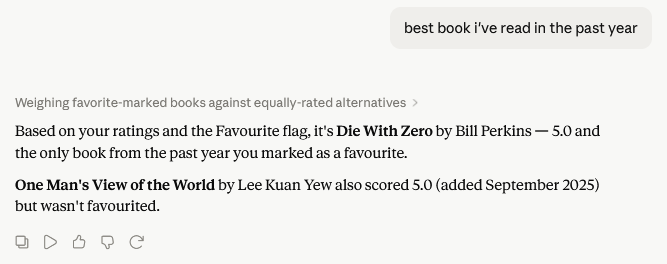
The database is also useful for finding the next book. When I asked Claude for a recommendation based on my reading list, it identified patterns in my ratings: practical frameworks, geopolitical systems thinking and personal optimisation. It then recommended Chip War by Chris Miller, which sits at the intersection of geopolitics and the technology industry, two subjects that clearly recur in my reading.
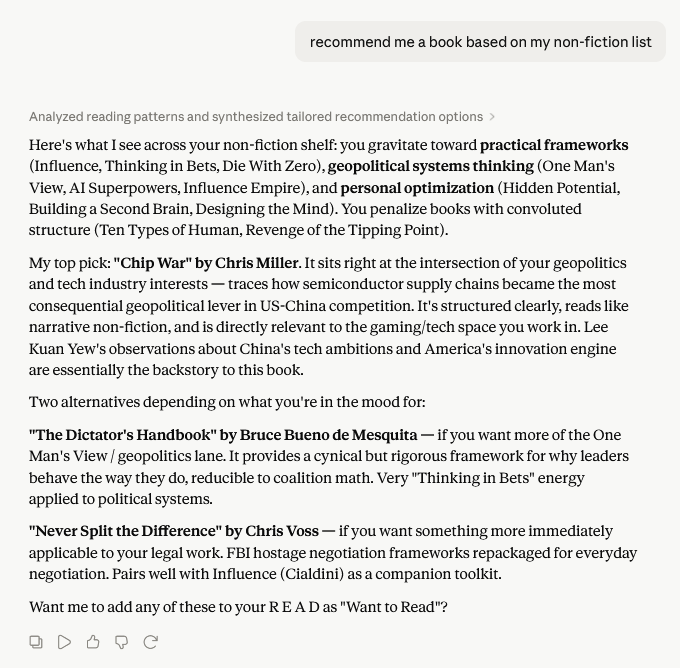
That is the value of keeping the record. It turns reading from a loose collection of impressions into a personal map of what I have found useful, interesting or worth returning to.
Restaurants
I have never been a foodie, and I still do not identify as one. I probably sit somewhere between the “live to eat” and “eat to live” camps. I do enjoy good food and visit highly-rated restaurants from time to time, which is probably helped by the fact that I have many foodie friends.
Previously, I was much worse at remembering where I had eaten. If someone asked me for a recommendation by cuisine, I would often struggle to name anything useful. Since I started maintaining a restaurant database in Notion more than a year ago, that has changed. I do wonder whether the act of consciously noting a restaurant and recording it as an entry helps sustain, or even strengthen, the memory of the place.
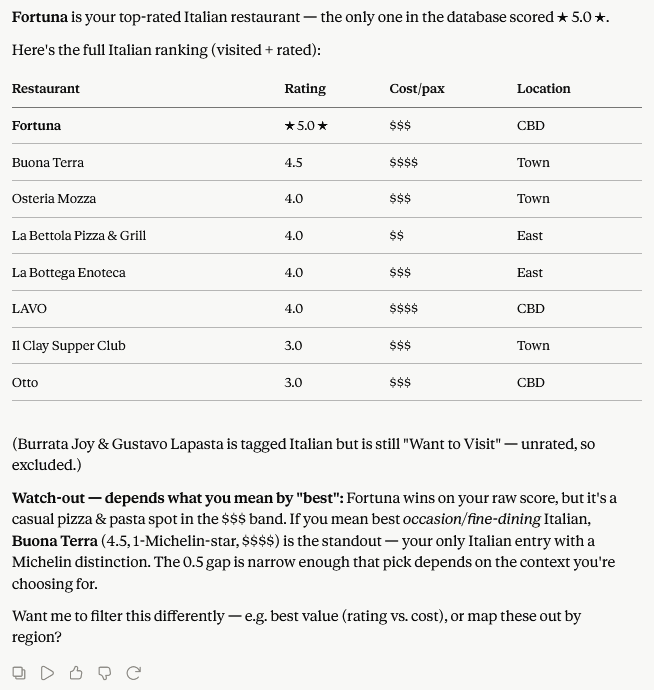
My restaurant tracker includes fields such as rating, cuisine, approximate cost per person and rough location. The rating runs in 0.5 increments up to 5.0, and the location categories are intentionally practical: North, South, East, West, Town, CBD and so on.
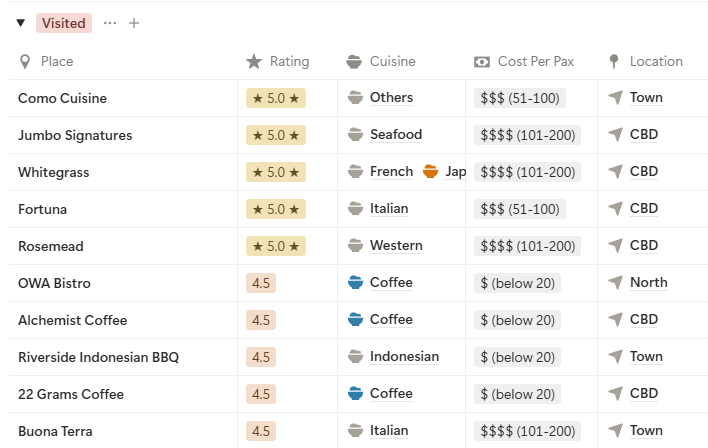
Adding an entry works the same way. I tell Claude the name of the restaurant and my personal rating. Sometimes I add a few favourite dishes. Sometimes I take a photo of the receipt, and Claude uses it to populate the entry with the dishes ordered during that visit.
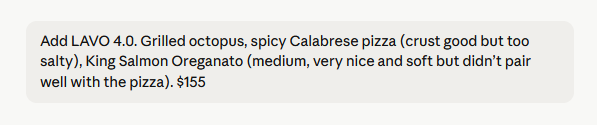
The next time a friend visits Singapore and asks where to go for Italian food, I can ask Claude to search my own restaurant tracker. The answer comes from my ratings and notes, not from a generic list of popular restaurants, and I can easily share my favourite dishes from that restaurant or let my friend know which ones to avoid.
Finally, one interesting and unintended phenomenon I have observed is that, over time, the databases seem to have improved my recall of the things I have recorded. I have better recommendations to offer when friends ask for books to read or restaurants to try, and a clearer understanding of what I generally like and dislike, because the entries accumulate into a record of my own taste.
Back to AI Journal